


Edited by
Céline Vacchiani-Marcuzzo, Université Paris Cité, France.
Denise Pumain is Geographer, Université Paris 1 Panthéon-Sorbonne, France.
ISBN : 9781789452280
Publication Date : March 2026
Hardcover 346 pp
165.00 USD
Co-publisher


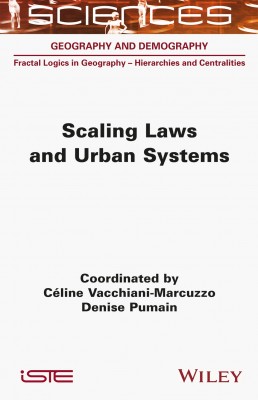
Interest in scaling laws has grown since the beginning of the 21st century. In both the social sciences and the natural sciences, there is continued astonishment at the increasing inequalities between large and small cities.
While social indicators are often thought of as linear measures, in terms of per capita quantities, economies of scale allow us to take account of sublinear relationships or superlinear relationships (amplifications), achieved according to the size of cities. Given the dual challenge facing cities in terms of ecological transition and technological innovation, it is crucial to inform urban policies about the effects of their size on the qualities of cities.
Scaling Laws and Urban Systems provides an overview of this new knowledge in terms of growth and adaptation capacities, resource extraction or environmental pollution, as well as the sustainability of the living conditions that cities now offer to the majority of the world’s population.
Part 1. Consolidating the Significance of Urban Scaling Laws 1.
1. Scaling Laws in Complex Systems Dynamics, Denise Pumain.
2. Epistemological and Critical Examination of Urban Scaling Laws, Cécile Tannier and Denise Pumain.
3. Generative Models of Hierarchical Systems of Cities: The Role of Individuals and Firms, Cécile Tannier.
4. Modeling Interactions Between Cities to Simulate Urban Hierarchies, Cécile Tannier.
Part 2. Revisiting International Comparison of Urban Systems with Scaling Laws.
5. Urban Functions and Scaling Laws: South Africa, United States, France, Céline Vacchiani-Marcuzzo and Fabien Paulus.
6. Scaling Laws and Integration Dynamics in Cities of the European Union, Olivier Finance and Denise Pumain.
7. The Integration of Cities with Globalization, From 2010 to 2022, Through the Lens of Scaling Laws, Céline Rozenblat.
Part 3. Scaling Laws to Better Characterize Urban Forms.
8. Intra-Urban Radial Scaling Laws, Justin Delloye, Estelle Mennicken, Paul Kilgarriff, Rémi Lemoy and Geoffrey Caruso.
9. A Method to Define Multiscalar Systems of Cities in France, Florent Le Néchet, Benoit Conti and Sylvestre Duroudier.
Céline Vacchiani-Marcuzzo is Geographer and Professor at Université Paris Cité, France. Her work focuses on the functional and relational aspects of cities (demographic dynamics, economic trajectories, mobility, etc.) from a comparative global perspective.
Denise Pumain is Geographer and Emeritus Professor at Université Paris 1 Panthéon-Sorbonne, France. As a specialist in urban dynamics, she questions the relevance of transferring models between the natural sciences and social sciences.


