


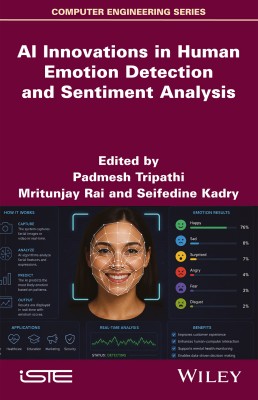
Edited by
Padmesh Tripathi, Delhi Technical Campus, India.
Mritunjay Rai, Shri Ramswaroop Memorial University, India.
Seifedine Kadry, Lebanese American University, Lebanon.
ISBN : 9781836690702
Publication Date : October 2026
Hardcover 452 pp
170 USD
Co-publisher


Human feelings, their simulation and the perception of them in the reality of the ever-changing environment of AI are some of the central ideas regarding the construction of intelligent, ethical and human-related systems.
AI Innovations in Human Emotion Detection and Sentiment Analysis covers the field of computational emotion analysis, using a mix of machine learning, deep learning, causal modeling, multimodal fusion and soft computing. It examines speech, text, facial expression and processing of physiological cues. It also solves problems such as uncertainty management, cross-cultural generalization, class imbalance and domain adaptation. This book covers advanced architectures, such as transformer encoders, recurrent networks, attention and parameter-efficient fine-tuning strategies, alongside explainability models and explainable AI. Both technical and emotion analytics are performed on organizational behavior, service innovation, human–AI synergy and Industry 5.0 prisms.
This book offers theorists, practitioners and graduate students a systematic approach to the creation of transparent, adaptive and socially responsible emotion-sensitive intelligent systems by integrating theoretical knowledge and practical experience and experimentation.
1. Advancements in Affective Computing: A Deep Learning Perspective on Sentiment Analysis and Emotion Detection, R. Kishore Kanna, Priyanka Singh, S. Raju and Ayodeji Olalekan Salau.
2. A Study on how Humanization of AI can Strengthen Emotional Intelligence in Hotel Operations: National and International Perspectives Through an ISM Approach, Sushma Sharma, Pawan Kumar and Shubhangi Tyagi.
3. A Multimodal Fusion Framework Using a Deep Learning Approach for Identification of Visual Emotion and Sentiment Analysis, Manisha, Pridhi Arora, Padmesh Tripathi, Preeti Katiyar and Mritunjay Rai.
4. Understanding Employee Sentiments: Leveraging Sentiment Analysis for Workplace Insights, Salini Rosaline and Muskan Jain.
5. Psychological Foundations of Human Emotion and its Relevance to AI, Roshitha Ratna Mallela, B. Naresh Kumar, Y. Sudhamini and G. Sriker Reddy.
6. Machine Learning Approaches for Sentiment Analysis, T.C. Swetha Priya and A. Kanaka Durga.
7. Natural Language Processing for Sentiment Analysis, P.R. Anisha, Umaima Qader Mohiuddin and Hajira Farooqui.
8. Decoding Human Affect: A Structural Equation Modeling Approach to Deep Learning-Based Emotional and Sentiment Analysis, Remmiya Rajan P., Kolapo Ige and Dineshan E.
9. AI in Analyzing Emotions on Social Media Platforms: A Paradigm Shift, Md. Saddam Hossain, Farhana Yeasmin and Md. Shajahan Kabir.
10. Human Emotion Recognition Using Speech Signals, Geetanjali Srivastava, Girish Sursakar, Akash Vishwakarma and Priyanka Jain.
11. Transforming Employee Relations: The Role of Speech Emotion Recognition in Modern HR Practices, Revati Ramrao Rautrao.
12. Fuzzy and Neutrosophic Logic-Based Models for Handling Uncertainty in Emotion Detection, Ajoy Kanti Das, Nandini Gupta, Suman Patra and Takaaki Fujita.
13. The Evolution of Emotion Research: From Darwin’s Theories to AI, Sirine Hadjer Zaabta, Omar Matari and Omar Sebbagh.
14. Real-Time Face Emotion Detection using Mobilenetv1 and Speech Emotion Recognition using Multimodal Analysis, Budhaditya Bhattacharyya.
Padmesh Tripathi is a professor in the Department of Computer Science and Engineering at the Delhi Technical Campus, India. His research expertise covers inverse problems, AI, image processing and optimization.
Mritunjay Rai is an assistant professor in the Department of Electrical and Electronics Engineering at Shri Ramswaroop Memorial University, India. His research specializes in digital image processing, thermal imaging and AI.
Seifedine Kadry is a professor of data science at the Lebanese American University, Lebanon. His research specializes in AI, machine learning, cybersecurity and educational technology.


