


Edited by
Yves Charbit, Université Paris Cité, France.
Eugenia Gómez del Rio, National University of Córdoba, Argentina.
James F. Hollifield, Southern Methodist University in Dallas, United States.
Sascha Krannich, IU University in Cologne, Germany.
ISBN : 9781789452457
Publication Date : November 2026
Hardcover 382 pp
170 USD
Co-publisher


Human rights are universal and inalienable, and impose obligations on states to protect individuals and groups. Yet immigrants and refugees often remain insufficiently protected against violations arising from migration policies. Although freedom of movement is affirmed in the Universal Declaration of Human Rights, many states restrict or disregard migrants’ fundamental rights in the name of migration control.
This three-volume series provides a global and interdisciplinary overview of the relationship between immigration policies and human rights. It draws on contributions from law, political science, history, demography, sociology and economics.
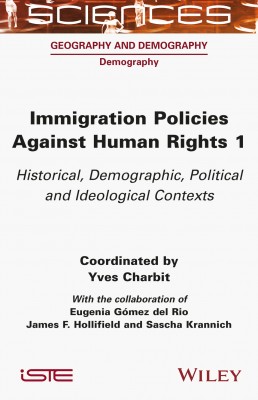
Immigration Policies Against Human Rights 1 offers an assessment of the historical, demographic, political and ideological contexts in ten major countries of immigration, some long-established and others more recent: Argentina, Spain, the United States, France, India, Italy, Morocco, Russia, Tunisia and Turkey. The first part of this book adopts a dual historical and demographic perspective. It analyses the relationship between the evolution of human rights and that of international migration law, highlighting both their points of convergence and their sources of tension. The second part focuses on the political and ideological dimension. It examines how immigration policies contribute to debates on xenophobia, racism and illiberalism, as well as their implications for the protection of human rights.
Part 1. Historical and Demographic Context.
1. Definition and Implementation of Human Rights in France (18th–20th Centuries), Ralph Schor.
2. French Immigration Policy 1945–2025, Catherine Wihtol de Wenden.
3. Xenophobic Populism and the Instrumentalization of African Demography, Yves Charbit.
4. Migration Flows and Political Realism in Spain (1991–2025), Juan David Sempere Souvannavong.
5. Italian Migration: Putting an End to its Segmented Representation, Adelina Miranda.
6. Migration and Migration Policies in the Soviet Union and the Russian Federation since 1945, Lewis H. Siegelbaum.
Part 2. The Political and Ideological Dimension.
7. Human Rights and International Displacement: Causes, Frameworks and Challenges, James F. Hollifield and Tessa Peterson.
8. The Tension Between Human Rights and International Migration, Serge Rabier.
9. Struggle and Solidarity: Nativism, Immigration and the Defense of Human Rights in the United States in the 21st Century, Neil Foley.
10. Indian Laws on Refugees and Hospitality Policy Since Independence, Hemaadri Singh Rana.
11. Updating the National Register of Citizens in Assam, India: The Birth of an Anti-Immigrant Discourse, Samir Kumar Das.
12. Towards a Moroccan Immigration and Asylum Policy Respectful of Human Rights, Nadia Khrouz and Mohamed Amarti.
13. System for the Protection of Sub-Saharan Children in Tunisia, Riadh Ben Khalifa.
14. Scientifically Criminalizing Immigrants (Argentina 1890–1914), Eugenia Scarzanella.
Yves Charbit is Professor Emeritus of Demography at Université Paris Cité, France. He is a specialist in population and development issues. Many of his publications focus on international migration and population policies.
With contributions from
Eugenia Gómez del Rio is Research Director at the National University of Córdoba, Argentina.
James F. Hollifield is Director of the Tower Center at Southern Methodist University in Dallas, United States.
Sascha Krannich is Professor at IU University in Cologne, Germany.


