


Benoit Beckers, Université de Pau et des Pays de l’Adour, France.
Pierre Beckers, Université de Liège, Belgium.
ISBN : 9781836690788
Publication Date : July 2026
Hardcover 186 pp
170 USD
Co-publisher


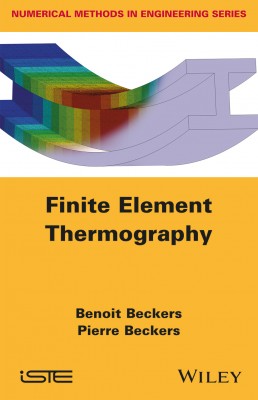
The thermal camera has revolutionized our understanding of heat transfer across many fields. In particular, it has enabled the visualization of surface temperature fields, which were previously only accessible through point sensors. However, thermograms are often difficult to interpret and can only be obtained from existing scenes. To understand them and extrapolate their insights to projects that have not yet been realized, a digital twin is required. This book examines how the finite element method facilitates the creation of idealized thermograms that both explain and extend measured situations.
Finite Element Thermography addresses steady-state and transient heat transfer, starting from diffusion equations. Their discretization leads to the classical formulation of the finite element method. This book then discusses thermal radiation, with the final chapter exploring the challenges of representing results and adapting them for the calculation of derived quantities, such as the mean radiant temperature.
Part 1. Thermal Diffusion.
1. Steady State.
2. Boundary Conditions.
3. Transient Response.
4. Isoparametric Elements.
Part 2. Thermal Radiation.
5. Black Bodies.
6. The Sun and Short Waves.
7. The Earth and Long Waves.
8. Mean Radiant Temperature.
Benoit Beckers is a professor at the Université de Pau et des Pays de l’Adour, France. His research focuses on the perception of sound, light and thermal waves, in connection with the history of architecture and urban planning.
Pierre Beckers is an emeritus professor at the Université de Liège, Belgium. His research focuses primarily on the finite element method, dual analysis, computer graphics and computer-aided design.


