

Edited by
Abhishek Kumar, Chandigarh University, Mohali, India.
Priya Batta, Amity University Punjab, Mohali, India.
Sachin Ahuja, Chandigarh University, Mohali, India.
Pramod Singh Rathore, Manipal University Jaipur, India.
ISBN : 9781836691334
Publication Date : August 2026
Hardcover 272 pp
170 USD
Co-publisher


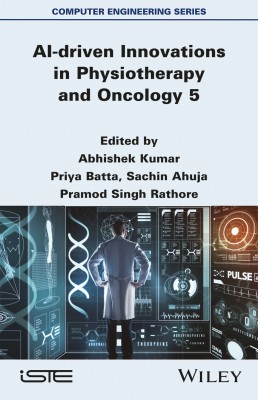
AI-driven Innovations in Physiotherapy and Oncology 5 explores how artificial intelligence (AI) is transforming modern healthcare by enabling smarter, more precise and patient-centered approaches. This book highlights the application of machine learning, deep learning and data analytics in enhancing rehabilitation and cancer care, from movement analysis and personalized physiotherapy to early detection and precision oncology.
Combining both theory and practice, this book presents interdisciplinary insights for researchers, clinicians and academicians, while addressing real-world implementations, emerging trends and ethical considerations. The book also positions AI as a key driver in advancing next-generation healthcare systems and improving clinical outcomes.
Part 1. AI, Data and Predictive Intelligence in Physiotherapy.
1. Physiotherapy Patient Records Enhanced with Natural Language Processing, Mandar Malawade and Rasika Ranjit Chafle.
2. Neural Network Models for Optimizing Rehabilitation Timelines, Namrata Kadam and K. Gavhale.
3. AI and Digital Twins for Personalized Physiotherapy Simulations, Chandrakant Patil and Swapna Kamble.
4. Machine Learning for Outcome Prediction in Orthopedic Physiotherapy, Poonam Patil and Jiwan Dehankar.
5. Computer-Vision-based Fall-Risk Assessment in Physiotherapy Patients, T. Poovishnu Devi and Chandrayani Rokde.
Part 2. Intelligent Rehabilitation Systems and Advanced Physiotherapy Technologies.
6. AI-Enhanced Virtual Reality Environments for Immersive Physiotherapy, S. Anandh and P. Bainalwar.
7. Predictive Modeling of Muscle Recovery Using Deep Learning, Suraj Kanase and Kalpana Malpe.
8. AI and Cloud-Based Platforms for Remote Physiotherapy Supervision, Sandeep Shinde and Shamla Mantri.
9. Machine Learning Algorithms for Movement Quality Scoring in Physiotherapy Sessions, Vaishali Jagtap and G.M. Vaidya.
10. AI-Powered Rehabilitation Robotics for Assisted Physiotherapy, Mandar Malawade and Fazil Sheikh.
Part 3. Specialized Applications and Emerging Perspectives.
11. Therapeutic Approaches in Cerebral Palsy, Mandar Malawade and G. Varadharajulu.
12. Knowledge, Attitude and Practice of Breast Self-Examination Among Women in the Era of AI-Driven Innovations in Physiotherapy and Oncology, Ankita Durgawale, Vaishali Jagtap, Trupti Yadav and Rujuta Nene.
Abhishek Kumar is an assistant director and professor in the Department of Computer Science and Engineering at Chandigarh University, Mohali, India. His research specializes in AI, renewable energy and image processing.
Priya Batta is an associate professor at Amity School of Engineering and Technology, Amity University Punjab, Mohali, India. Her research specializes in AI, blockchain and the IoT.
Sachin Ahuja is the Executive Director of Engineering and a professor at Chandigarh University, Mohali, India. His research specializes in AI, machine learning and data mining.
Pramod Singh Rathore is an assistant professor at Manipal University Jaipur, India. His research interests include NS2, networks, data mining and DBMS.